
Official sources said the notice under section 201 and 220 (2) of the I-T Act, which talks about simple interest at one and a half per cent for every month the tax demand was raised, will also explain the retrospective amendment made by the government for taxing business deals that avoids tax in the country by showing them in a tax haven.

The three new laws -- the Bharatiya Nyaya Sanhita, the Bharatiya Nagarik Suraksha Sanhita and the Bharatiya Sakshya Act -- will replace the colonial era Indian Penal Code, the Code of Criminal Procedure and the Indian Evidence Act of 1872.

The Central Reserve Police Force has suspended a senior DIG-rank officer for sharing content allegedly "against" the government during the recent passage of the Central Armed Police Force bill, which the cadre officers of these forces had called discriminatory.

President Droupadi Murmu has given her assent to the Viksit Bharat Guarantee for Rozgar and Ajeevika Mission (Gramin) Bill, which aims to replace MGNREGA and guarantee 125 days of wage employment per rural household.

The Dravida Munnetra Kazhagam on Thursday said that it will move the Supreme Court against the delimitation bill, if it is passed in the Parliament.

The Tamil Nadu assembly on Tuesday once again adopted the anti-NEET Bill, returned days ago to the government by Governor RN Ravi, with the ruling Dravida Munentra Kazhagam and principal opposition All India Anna DK reaffirming their opposition to the test.
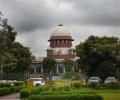
A five-judge Constitution bench of the Supreme Court is scheduled to consider the Presidential reference on whether timelines could be imposed by judicial orders for the exercise of discretion by the President while dealing with bills passed by state assemblies.

Karnataka Governor Thaawarchand Gehlot has reserved the Bill pertaining to four percent reservation for Muslims in government contracts for the President's assent, citing constitutional concerns. The Bill, which has been a subject of controversy in Karnataka, was passed by both houses of the state legislature amid protests from the opposition BJP. The Governor's decision to reserve the Bill highlights the ongoing debate over the constitutionality of religious-based reservations in India.

The government has released a set of FAQs to address concerns and clarify the details surrounding the Women's Reservation Bill, which aims to provide 33 per cent quota for women in legislatures.

BJP-ruled states argued in the Supreme Court that governors and the President have autonomy in assenting to bills passed by state assemblies, asserting that courts cannot mandate assent.

The Supreme Court has questioned the practice of Governors withholding assent to bills indefinitely, stating that it renders the constitutional provision of 'as soon as possible' meaningless.

While the governor gave his assent to the significant public health bill, he has reserved seven bills, including the controversial University Amendment Bill, for presidential assent, Raj Bhavan said on Tuesday.
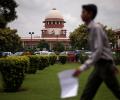
The Tamil Nadu government has argued in the Supreme Court that Governor R N Ravi's repeated withholding of assent to bills passed by the state legislative assembly would lead to the failure of the democratic system in India. The top court has questioned the delay by the Governor in granting assent to several bills passed by the state assembly and asked why governors should wait for parties to move the court with their grievances. The court has also said that the Governor cannot refer bills passed by the legislature and re-adopted by it for presidential assent.

Tamil Nadu Chief Minister M K Stalin has announced that the state's Assembly resolution seeking NEET exemption, which was sent for Presidential assent, has been declined by the Centre. Stalin termed the rejection as a "dark chapter in federalism" and accused the Centre of disregarding the will of the Tamil Nadu people. He also announced an all-political party meeting on April 9 to discuss the issue further.
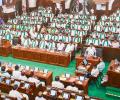
=In 21 states, the time gap between the general Budget and ministry-specific discussions was just one day.
The Tamil Nadu government has urged the Supreme Court to dismiss the Presidential reference concerning the Governor's powers to assent to bills, arguing it is an 'appeal in disguise' to overturn settled law.

With the livelihood of nearly 5,000 people at stake, and FIFA, the Asian Football Confederation and global players' union FIFPRO keeping a close watch, the Court fixed August 28 as the next date of hearing.
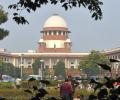
The Supreme Court has scheduled hearings starting August 19 for the Presidential Reference concerning constitutional issues related to timelines for handling bills passed by state assemblies. The court has directed the Centre and states to submit written arguments by August 12.

The Supreme Court of India has ruled that a governor has discretion under Article 200 to refer a state bill to the President or return it to the legislature, and is not bound by the advice of the council of ministers. The court clarified that a governor cannot simply withhold a bill.
The Supreme Court of India has ruled that the actions of governors and the President in granting, withholding, or reserving assent to bills are not subject to judicial review, emphasizing the separation of powers.

The National Sports Governance Bill has become an Act after President Droupadi Murmu gave her assent to the landmark legislation that promises to revamp India's sports administration.

Head Digital Works, operator of 'A23 Rummy', has filed a petition in the Karnataka High Court against the recently passed Central Act banning money-based online games, marking the first legal challenge to the legislation. The court will hear the petition on August 30.

The Uniform Civil Code bill was passed by the state assembly and also received the presidential assent recently after which it has become a law.
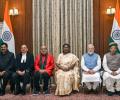
The Supreme Court's opinion on the presidential reference can impact on any number of cases if and when governors, if not the President, take a literary view of the Supreme Court's 'ppinion' on their 'discretionary powers' without reference to the rider on 'reasonable time', points out N Sathiya Moorthy.

Tamil Nadu Chief Minister and Dravida Munnetra Kazhagam president M K Stalin on Friday asserted that "there will be no rest" until amending the Constitution to fix timelines for governors to clear bills.

The Supreme Court on Thursday held that the Governor can reserve a bill for consideration of the President even in the second instance, when the bill is again sent by the state assembly to him whether in its amended or unamended form.

'It makes law-making on the part of the state governments much more difficult and throws up bottlenecks as governors are not acting on bills.'

'Money moves in a web of transactions and payment addresses keep changing for offshore companies, which requires heightened monitoring measures.'
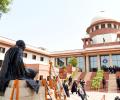
Calling itself the "custodian of the Constitution", the Supreme Court on Thursday asked if it could "sit idle" if a constitutional functionary like governor failed to discharge duties, as it reserved its verdict on the presidential reference on grant of assent to bills.

The Centre has told the Supreme Court that imposing fixed timelines on governors and the president to act on bills passed by a state Assembly would amount to one organ of the government assuming powers not vested in it by the Constitution and lead to a "constitutional disorder".

'In consultations, several stakeholders, including athlete representatives and smaller federations, highlighted that overly restrictive eligibility rules tended to entrench incumbents and limit opportunities for fresh leadership.'

The Delhi services bill that entails the creation of an authority for the transfer and posting of Group-A officers in the national capital and gives the central government primacy over such appointments has received presidential assent.

The Supreme Court has ruled that a Governor cannot send bills to the President for consideration if the state assembly has already cleared them for a second time. The court was questioning the Centre over the powers of the Governor when it comes to granting assent to bills.
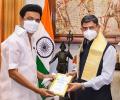
Stalin called on Ravi at the Raj Bhavan here and urged him to expeditiously send the Bill to exempt Tamil Nadu from the purview of the National Eligibility cum Entrance Test for getting Presidential assent, an official release said.

'If a charitable or religious trust sells a capital asset -- such as land, buildings, shares -- and makes a capital gain, it can avoid paying tax on that gain if it reinvests the proceeds in another capital asset for its charitable purposes.'

The West Bengal Assembly had in a special session last week passed the West Bengal Protection of Interest of Depositors in Financial Establishment Bill, 2013, to protect investors in chit fund companies.

The National Rural Employment Guarantee Act, 2005, will be applicable to whole of India except Jammu and Kashmir, an official release said.
The Tamil Nadu assembly bill seeking exemption to the state from the ambit of the National Entrance-cum-Eligibility Test has been sent to the Centre for presidential assent by Governor R N Ravi, Chief Minister M K Stalin said on Wednesday.

In multilateral contests, it would go by the Olympic Charter, which prohibits any discrimination based on political issues, which is why the government has stated that it would not stop Pakistan from coming to India for international events.

The Centre has argued before the Supreme Court that state governments cannot use writ jurisdiction to challenge the actions of the President and Governor regarding bills passed by state assemblies, particularly concerning fundamental rights violations. The President seeks the Supreme Court's opinion on whether states can file writ petitions under Article 32 and the scope of Article 361.
